This article was originally published in The Bushcraft & Survival Skills Magazine
Ancient Sentinels
I have always been drawn to trees, fascinated I suppose by their aura of permanence. Many species if allowed can live to a very great age, theoretically trees can carry on living almost indefinitely so long as they do not succumb to disease or damage.
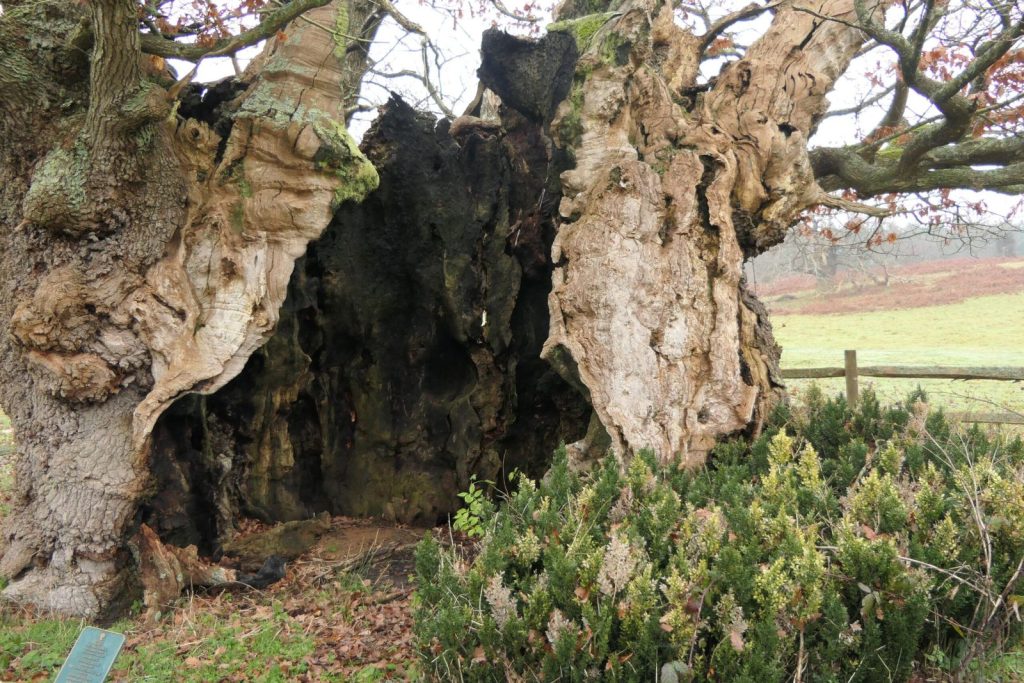
In the UK we have more ancient and veteran trees than anywhere else in Europe. However veteran tree is not necessarily old, and many young trees have veteran features. One definition of a veteran tree I particularly like is “a tree suffering from the rigours of life”. Generally speaking, this means that the individual tree will have holes, cavities, flaking bark and all manner of features that to the uninitiated may look like the tree is in imminent danger of collapse. In some instances, this may indeed be the case but trees that are growing old gracefully and naturally do have strategies for dealing with the decline in their general structural and physiological vigour.
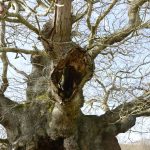
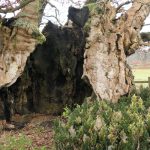
How trees age.
There is a saying that an oak tree spends 300 years growing, 300 years living and 300 year slowly dying. And this may be true although it may be difficult to say for sure how exactly a trees live cycle fits in with the passing of time. Partly this is because they travel the centuries in what are effectively eons compared with our own short journeys and also because in much of northern Europe they are messed with. Frequently ancient trees have removed for safety reasons or been swamped by faster growing trees. It can be hard therefore for us to be sure exactly where trees would end up naturally.
Not all tree species are equipped for a long-life, a birch, unlike an oak invests much less energy in growing slowly and harbouring its resources for times of trouble instead adopting a rock and roll lifestyle living fast and dying young. Their roll in the ecosystem is that of a pioneer, colonising open ground and creating a forest environment. If they reach a century they are doing well.
There are exception and some tree species behave differently but generally speaking when a tree is young it spends its time gathering energy and using that energy to grow tall and become a canopy tree. It can then set seed and reproduce itself, there is little point in carrying on growing once the canopy is achieved as being taller makes for exposure to wind and also leads to problems with water and nutrient uptake among others.
All trees are capable of rapid growth but taking a slower attitude to life and harbouring some of that energy for a rainy day, so to speak, means that options exist for surviving lean, drought years or fending off defoliation insects or having energy to seal of infection from bacteria and fungi.
Once a tree that through more conservative lifestyle choices, reaches a certain height and maturity it begins a process known as retrenchment. Essentially this involves the dying back of the upper crown while a smaller secondary crown forms lower down. This can often be seen in many older oaks throughout the country. It may be caused also by damage to the tree but is normally recognisable by the obvious thinning of the upper branches but the lower ones still being dense and hard to see through. At the same time the tree will also become hollow with the aid of helpful fungi and then send aerial roots into its own rotted heartwood and eat itself. These aerial roots can in some instances form a separate plumbing system to the lower crown branches that become effectively smaller versions of the adult tree. For this reason, they are known as reiterant trees.
Oaks become known as stag headed as the upper crown eventually disappears leaving on the desiccated heartwood of the older canopy in the form of the spiny wood so highly prized by cold bushcraft practitioners and log merchants alike.
A short squat hollow structure frequently survives gales and storms better that a young tall and perhaps more vigorous tree. The Elisabeth oak at Cowdray Park in West Sussex is very short and very wide and has survived the century’s despite being in a relatively exposed position in the remnants of old wood pasture.
Some species do not die back slowly and instead do it all on one dramatic effort. Beech are example of this and will often snap themselves in half or even lower and then carry on for many decades on a much-reduced canopy. This, together with summer branch drop, is one reasons why mature beech trees can be dangerous to camp under.
I have seen this mechanism in action across the northern hemisphere and in primary forests of the pacific Norwest of America and with conifers as well as broadleaved trees.
One of the reasons we in the UK have so many ancient trees is due to management systems that exploit the tree regenerative power to keep re growing and the retrenchment mechanism. Once the crown is lost then the tree will send up reiterant versions of itself from dormant buds if this happens low down it results in a coppice stool if higher up it creates a pollard.
This pollarding creates the hollowing out seen in ancient trees but when is done in a regular cycle effectively restarts the tree again creating specimens that may live many times longer than an unmanaged tree. It is possible to find pollard oaks in Windsor great park that are described in the doomsday book of 1086. Presumably they at that time large enough to be noteworthy and so already a fair bit older than the 900-year life span credited to an oak tree.
In years gone management by pollarding was quite extensive with the new growth from the pollards kept above the height of grazing animal which could be run underneath as a kind of early permaculture. Periodic cutting of the branches provided fodder and timber and re invigorated the tree in an almost endless cycle. The landscape produced, known as wood pasture, is a form of woodland and very old and increasingly rare. There are exemptions but many surviving woodlands of this type are now sparsely stocked and often have no “new” ancients waiting to replace the old when they finally succumb.
Benefits of ancient trees
An ancient tree be it a pollard or a more naturally declining individual is a living ecosystem in its own right. Supporting an amazing array of species not just those that use the inevitable holes and cavities found in these trees, but also are host to range of specialists found only here. These include fungi which also help with the hollowing out process, saproxylic beetles whose larvae live in the wood pulp in the hollow steams and bryophytes finding a foothold in the cracks, crevices and bumps inevitable on an ancient tree. Many of these species are threatened and are red data book listed.
Some of the insects associated with these trees are particularly vulnerable as the adults need nectar and therefore flowering plants close by this would of course have been provided in the pastures of yesteryear. It could be possible that such specialist requirements of ancient hollowing trees and land open enough to support flowering plants support the theory of Frans Vera that our ancient pre managed forests where a much more open savannah type of growth with pockets of woodland and pastures kept open by grazing animals.
Ancient and veteran trees also link us to our own social history we have perhaps all heard of the major oak, hiding place of Robin Hood, or the Sycamore tree that the Tolpuddle martyrs met under. You may also find tree history local to you, the Elisabeth oak mentioned early is rumoured to have been named after Queen Elisabeth the 1st . According to one story she shot a stag from under its shade with a longbow during a visit to Cowdray estate. This tree is a ten-minute drive from where I live.
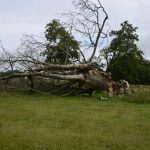
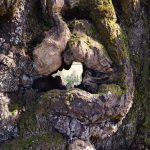
Threats to ancient trees.
Ancient and veteran trees are of lower vigour than the youngsters just embarking on life. The biggest threat to them is often overshadowing by younger more vigorous trees, often twisted and gnarled they may have been left in forests as being more trouble that they are worth to fell. Consequent replanting, often with fast growing conifers, sees them frequently struggling for light and therefore food. Carefully planning is required to release these trees as sudden exposure to sunlight and wind by the removal of competition can open them up to forces, that they cannot deal with.
Compaction is also an issue people cattle and machines with too much access to the roots particularly when the ground is soft can force the air out of the soil and in extreme situations kill the tree.
Livestock can also skin the bark from exposed roots and strip the bark from the truck itself, I have seen hollows opened up by cattle and the wood pulp scattered. From an ecological perspective and intact cavity full of wood mulch is much more valuable than an empty one.
Tidying up excessively is also potentially damaging, trees often gently lower branches either through just growing down or by partially breaking. These can act as support to the tree and may even root and great another specimen. Yew trees do this regularly, Kingley vale in West Sussex is the biggest yew forest The UK and possibly Europe and has some specimens that could be 2000 years old according to some estimations. They regularly drop branches in support and these also root. This leads to an obvious thought that the old trees may also have once been rooted branches, so on back perhaps as far as the last ice age. Could it be that these ancient wanders have been marching across our landscape for 8000 years making even the slowest of Ents appear hasty?
Removing these untidy falling branches robs the tree of support and perhaps confines to the life in the same location.
Anything that does fall from the tree should be stacked in close proximity as intermediate habitat. When veteran trees finally succumb, they should also not be removed. The importance of deadwood in conservation cannot be overstated.
Changes in land management and fears of safety have unfortunately left us with perhaps a more serious threat that any listed above. There are very few if any areas where veteran trees are being created to replace the old ones. Even should this change we still face a big age gap; we may have new trees encouraged and old veteran trees falling apart but nothing in between. The associated rare species do not travel great distances and having one old tree in a landscape devoid of other trees also aged or aging doesn’t bode well for its inhabitants.
It is possible to fill the gap to some extend at least temporarily by veteranizing young trees to create the habitat. For all the students I have taught the essential principles of proper pruning I apologise now. Veteranizing trees involves practices designed to make the tree suffer the rigours of life before it is perhaps ready. This include bark removal, snapping branches to create ragged snags for over wintering insects and bats roosts and in extreme situation as resulted in the blowing up of the crown with dynamite. I was involved many year ago with some of this work in Windsor great park when I taught arboriculture at Merrist Wood College. Under the guidance of the remarkable Ted Green, a founder of the ancient tree forum, we snapped of branches using winches and even feel huge trees and then winched them upright and connected them to living trees with cargo straps to make standing deadwood. All of this was very experimental 30 years ago which to give him credit just shows how forward think Ted was.
One of the saddest things about our trees is our own attitude towards them, we would not hesitate to protect a man-made ancient monument with the full force of the law. Unfortunately, the needs of a tree which may be centuries older is often overlooked.
Something we should remember when building high speed rail links and roads and houses, to walk under ancient trees in ancient forests is to walk in the footsteps of wolves, bears and lynx. It is to follow hunter gathers, Celts and Romans and all the other wildlife and races that have come and gone since and is irreplaceable.